

Manuscript accepted on : 28-08-2025
Published online on: 23-09-2025
Plagiarism Check: Yes
Reviewed by: Dr. Ana Golez
Second Review by: Dr. Bhavesh Patel and Dr. Ahmed. Y Radeef
Final Approval by: Dr. Eugene A. Silow
Soniya Subramanian, Kamakshi Sampath Kumar and Siva Rajagopal*
Department of Plant Biology and Plant Biotechnology, Shrimathi Devkunvar Nanalal Bhatt Vaishnav College for Women, Tamil Nadu, India.
Corresponding Author E-mail :siva.r@sdnbvc.edu.in
ABSTRACT: Nanotechnology has emerged as a versatile field with applications across numerous disciplines. This study focuses on the biosynthesis of iron nanoparticles (FeNPs) using an aqueous extract of Lentinus squarrosulus. The formation of FeNPs was confirmed by a distinct color change at 60°C, followed by spectroscopic analyses, including ultraviolet-visible (UV-Vis) and Fourier-transform infrared (FTIR) spectroscopy. The antibacterial efficacy of FeNPs was assessed against Escherichia coli, Pseudomonas aeruginosa, Bacillus subtilis, Streptococcus mutans, Enterococcus faecalis, and Enterobacter aerogenes, demonstrating significant inhibitory activity. Additionally, FeNPs exhibited notable photocatalytic degradation of Methylene Blue, Fast Green, and Congo Red dyes, highlighting their potential for wastewater treatment. The findings suggest that FeNPs synthesized via Lentinus squarrosulus could be valuable in biomedical applications and environmental remediation.
KEYWORDS: Antibacterial activity; Dye degradation; Iron nanoparticles; Lentinus squarrosulus; Photocatalytic activity; Wastewater treatment
| Copy the following to cite this article: Subramanian S, Kumar K. S, Rajagopal S. Photocatalytic and Antibacterial Activity of Iron Nanoparticles Synthesized from Lentinus Squarrosulus Against Human Pathogens. Biotech Res Asia 2025;22(3). |
| Copy the following to cite this URL: Subramanian S, Kumar K. S, Rajagopal S. Photocatalytic and Antibacterial Activity of Iron Nanoparticles Synthesized from Lentinus Squarrosulus Against Human Pathogens. Biotech Res Asia 2025;22(3). Available from: https://bit.ly/46wZUHp |
Introduction
Mushrooms have long been recognized for their nutritional, medicinal, and ecological importance. Among them, Lentinus squarrosulus, a white rot fungus, has emerged as a promising species due to its ability to degrade lignocellulosic materials and produce bioactive compounds. It serves as a potent natural recycler, converting agricultural waste into protein-rich biomass while also producing a range of bioactive secondary metabolites.1 Its ability to accumulate metals and secrete extracellular enzymes makes it a suitable candidate for green synthesis of nanoparticles.2 The intersection of nanotechnology and biology has given rise to the field of green nanotechnology, where biological systems are employed to synthesize functional nanomaterials. Fungal-mediated synthesis of metal nanoparticles is gaining momentum as a sustainable alternative to chemical and physical methods. This approach offers multiple advantages including eco-friendliness, low toxicity, cost-effectiveness, and ease of scale-up. Mushrooms are excellent biological factories owing to their enzymatic and metabolic capabilities, which aid in both the reduction and stabilization of metal ions during nanoparticle formation.3 Iron, an essential micronutrient, plays a vital role in several physiological functions such as oxygen transport, ATP synthesis, and DNA replication. However, its bioavailability in biological systems is often hindered by oxidation and low solubility. Iron nanoparticles (FeNPs) overcome these limitations by exhibiting high surface area, catalytic activity, and magnetic responsiveness, thus enabling enhanced bioavailability and multifunctionality.4 Recent studies have demonstrated that FeNPs exhibit potent antimicrobial properties due to their ability to disrupt microbial membranes, generate reactive oxygen species (ROS), and inhibit essential enzymatic functions.5 This makes them highly effective against a wide range of bacterial and fungal pathogens, highlighting their potential in pharmaceutical and food preservation applications. Furthermore, FeNPs possess strong photocatalytic properties that enable the degradation of various toxic dyes and industrial pollutants, making them attractive agents for environmental remediation.6 Unlike conventional treatments, FeNPs can degrade pollutants without leaving harmful residues, making them an eco-friendly and efficient alternative.Given the multifunctional properties of FeNPs and the biosynthetic potential of Lentinus squarrosulus, integrating these two systems presents a novel and sustainable strategy for developing nanomaterials with dual applications. The present study aims to biosynthesize iron nanoparticles using L. squarrosulus and evaluate their antibacterial and photocatalytic properties. The results are expected to contribute to the development of green nanotechnological solutions for both biomedical and environmental challenges.
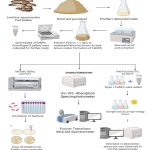 |
Figure 1: Graphical Representation of Photocatalytic and Antibacterial Activity of Iron Nanoparticles Synthesized from Lentinus squarrosulus Against Human Pathogen |
Materials and Methods
Collection and Preparation of Mushroom Extract
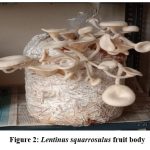 |
Figure 2: Lentinus squarrosulus fruit body |
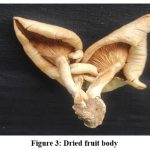 |
Figure 3: Dried fruit body |
Fresh fruit bodies of Lentinus squarrosulus were cultivated from the culture (Accession No. OR481908)procured from the Plant Biology and Plant Biotechnology lab which was previously collected from decaying Nerium odorum wood in Tambaram, Chengalpattu district. The mushrooms were cleanedto remove dirt before being dried using oven-drying at 40-50°C to preserve bioactive compounds.2 Once dried, they were ground into a coarse powder using a grinder or mortar and pestle, increasing surface area for extraction. The powdered mushrooms were mixed with water in a 1:10 ratio and heated at 60°C for 2-4 hours to facilitate the extraction of water-soluble bioactive compounds. The extract was then filtered through a fine mesh or filter paper to remove solid residues, resulting in a clear liquid extract. The filtered extract was stored at 4°C in sealedcontainers to maintain stability and prevent degradation.7
A 1 M ferric chloride (FeCl₃) solution was prepared using deionized water. Equal volumes of mushroom extract and the FeCl₃ solution were combined and incubated at a temperature range of 50 to 60°C with constant stirring. A progressive color transformation from brown to dark red signified the formation of iron nanoparticles (FeNPs). The synthesized FeNPs were subjected to centrifugation, followed by three washing cycles with distilled water. Subsequently, they were dried in a hot-air oven and stored for characterization.2
Characterization of Iron Nanoparticles
UV-Vis spectroscopy (200–800 nm) was used to confirm FeNP synthesis by detecting their surface plasmon resonance (SPR) band, indicative of nanoparticle formation and influenced by size, shape, and aggregation. Additionally, FTIR spectroscopy (4000–400 cm⁻¹) identified functional groups stabilizing FeNPs, such as hydroxyl, carboxyl, amine, and carbonyl groups, providing insights into surface interactions crucial for various applications.
Photocatalytic Activity
FeNPs were evaluated for dye degradation efficacy using Methylene Blue, Fast Green, and Congo Red dyes. Dye solutions (10 mg/L) were prepared, and FeNPs (10 mg) were added under sunlight exposure. The absorbance of the samples was recorded at different time intervals (0, 30, 60, 90 minutes) using a UV-Vis spectrophotometer.8 Decolorization efficiency was calculated using the formula:
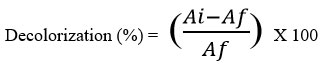
where Ai and Af represent initial and time-dependent absorbance values, respectively.
Antibacterial Activity
The antibacterial efficacy of FeNPs was assessed using the agar well diffusion method against E. coli, P. aeruginosa, B. subtilis, S. mutans, E. faecalis, and E. aerogenes. Wells were inoculated with FeNP solutions of varying concentrations (20, 40, and 60 μg/ml). Ampicillin (100 mg/ml) served as the positive control, while FeCl₃ solution was the negative control. The diameter of inhibition zones was measured after 24 hours of incubation at 37°C.9
Results
Synthesis and Characterization of FeNPs
The formation of FeNPs was visually confirmed by a color change from brown to dark brown. UV-Vis spectral analysis revealed absorption peaks at 282 nm and 532 nm, indicative of FeNP formation. FTIR spectra identified peaks at 517 cm⁻¹ and 621 cm⁻¹, corresponding to Fe–O stretching, while peaks at 1020 cm⁻¹, 1612 cm⁻¹, and 3431 cm⁻¹ indicated the presence of functional groups involved in nanoparticle stabilization.
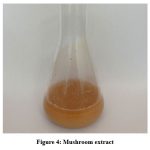 |
Figure 4: Mushroom extract |
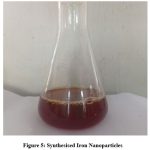 |
Figure 5: Synthesised Iron Nanoparticles |
UV-Vis spectral analysis further validated the formation of FeNPs, revealing absorption peaks at 282 nm and 538 nm. The peak around 282 nm corresponds to electronic transitions within iron species, while the 532 nm peak is indicative of the characteristic SPR of FeNPs, confirming their nanoscale nature.10
Fourier-transform infrared (FTIR) spectroscopy provided insights into the functional groups involved in nanoparticle formation. The observed peaks at 517 cm⁻¹ and 621 cm⁻¹ correspond to Fe–O stretching vibrations, confirming the presence of iron-oxygen bonds, which are indicative of iron oxide formation. Additionally, peaks at 1020 cm⁻¹, 1612 cm⁻¹, and 3431 cm⁻¹ suggest the presence of organic functional groups, possibly from biomolecules or capping agents involved in nanoparticle stabilization. The peak at 3431 cm⁻¹ is particularly indicative of hydroxyl (-OH) stretching vibrations, which may arise from residual water or hydroxyl groups interacting with FeNPs, further supporting their stabilization.
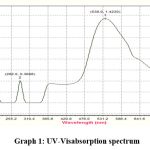 |
Graph 1: UV-Visabsorption spectrum |
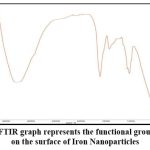 |
Graph 2: FTIR graph represents the functional groups present on the surface of Iron Nanoparticles |
Photocatalytic Activity
FeNPs have demonstrated significant efficiency in degrading various organic pollutants. For instance, green-synthesized iron oxide nanoparticles (IONPs) have shown high photocatalytic degradation efficiencies for dyes such as methyl violet, methyl orange, and Congo red, achieving degradation rates up to 89.93%.14
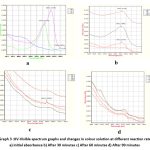 |
Graph 3: UV-Visible spectrum graphs and changes in colour solution at different reaction rate a) initial absorbance b) After 30 minutes c) After 60 minutes d) After 90 minutes. |
The reusability of these nanoparticles over multiple cycles without significant loss of activity underscores their potential for sustainable wastewater treatment.
Antibacterial Activity
The antimicrobial properties of FeNPs have been extensively studied, revealing their effectiveness against a range of pathogens. The generation of reactive oxygen species (ROS) by FeNPs plays a crucial role in their antibacterial mechanism, leading to the disruption of bacterial cell membranes and inhibition of enzyme activity. Studies have shown that the antibacterial efficacy of FeNPs varies depending on the microorganism and synthesis method.
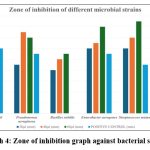 |
Graph 4: Zone of inhibition graph against bacterial strains |
Discussion
The successful formation of iron nanoparticles (FeNPs) was visually confirmed by a color change from brown to dark brown, indicating nanoparticle synthesis. This observation aligns with previous studies where the synthesis of iron oxide nanoparticles resulted in a noticeable color shift due to surface plasmon resonance (SPR) effects.Similar UV absorption features have been reported in the literature, with iron oxide nanoparticles exhibiting absorption peaks between 230 nm and 330 nm.11 These FTIR findings are consistent with previous reports where Fe–O stretching vibrations were observed around 577 cm⁻¹ and 631 cm⁻¹.12,13These findings confirm the successful synthesis of FeNPs and highlight the role of functional groups in their formation and stabilization. The presence of organic functional groups suggests possible interactions with biomolecules, which may contribute to enhanced stability and potential applications in biomedicine, catalysis, and environmental remediation. The reusability of these nanoparticles over multiple cycles without significant loss of activity underscores their potential for sustainable wastewater treatment. 15Advancements in the design of iron-based photocatalysts, including the development of heterojunctions and metal doping, have been shown to enhance photocatalytic performance. These modifications improve charge carrier separation and extend light absorption ranges, thereby increasing the efficiency of pollutant degradation.16,17For example, iron oxide nanoparticles have demonstrated significant antibacterial activity against both Gram-negative and Gram-positive bacteria, with low toxicity toward eukaryotic cells.18 Additionally, metal-doped iron oxide nanoparticles have emerged as promising agents for combating microbial infections, offering enhanced antimicrobial properties. 19These findings suggest that FeNPs, particularly when optimized through doping and functionalization, hold significant promise as photocatalysts for environmental remediation and as antimicrobial agents in medical applications.
Conclusion
The successful green synthesis of iron nanoparticles (FeNPs) using Lentinus squarrosulus highlights the remarkable potential of fungal-mediated nanotechnology in addressing current biomedical and environmental challenges. The biosynthesized FeNPs exhibited strong antibacterial activity, particularly against Streptococcus mutans, and demonstrated efficient photocatalytic degradation of industrial dyes, indicating their multifunctional efficacy. These properties not only validate the antimicrobial and environmental capabilities of FeNPs but also reflect the inherent advantages of utilizing biological systems for nanoparticle synthesis, including cost-effectiveness, eco-friendliness, and biocompatibility.
Furthermore, the use of L. squarrosulus as a sustainable bioresource strengthens the case for integrating mycogenic nanoparticles into real-world applications. Overall, FeNPs synthesized through this eco-friendly approach hold great promise as innovative agents for both therapeutic interventions and wastewater treatment technologies, paving the way for greener and more efficient nanobiotechnological solutions.
Acknowledgment
The authors express gratitude to the Management, Principal and the faculty members of the Department of Plant Biology and Plant Biotechnology for their support.
Funding Sources
The author(s) received no financial support for the research, authorship, and/or publication of this article.
Conflict of Interest
The authors do not have any conflict of interest.
Data Availability Statement
The manuscript incorporates all datasets produced or examined throughout this research study.
Ethics Statement
This research did not involve human participants, animal subjects, or any material that requires ethical approval.”
Informed Consent Statement
This study did not involve human participants, and therefore, informed consent was not required.
Clinical Trial Registration
This research does not involve any clinical trials.
Permission to reproduce material from other sources
Not Applicable
Author Contributions
Soniya Subramanian: Writing-introduction, methodology and Data analysis
Kamakshi SampathKumar: Writing Results and discussion, Review and editing
Siva Rajagopal: Supervision and finalised the manuscript
References
- Elsakhawy T, Omara AED, Abowaly M, et al. Green Synthesis of Nanoparticles by Mushrooms: A Crucial Dimension for Sustainable Soil Management. Sustainability (Switzerland). 2022;14(7). doi:10.3390/su14074328
CrossRef - Manikandan G, Ramasubbu R. Biosynthesis of Iron Nanoparticles from Pleurotus florida and its Antimicrobial Activity against Selected Human Pathogens. Indian J Pharm Sci. 2021;83(1). doi:10.36468/pharmaceutical-sciences.748
CrossRef - Sudheer S, Bai RG, Muthoosamy K, Tuvikene R, Gupta VK, Manickam S. Biosustainable production of nanoparticles via mycogenesis for biotechnological applications: A critical review. Environ Res. 2022;204:111963. doi:10.1016/J.ENVRES.2021.111963
CrossRef - Pavlov YS, Revina AA, Souvorova O V., et al. Electron beam agrobionanotechnologies for agriculture and food industry enabled by electron accelerators. In: Journal of Physics: Conference Series. Vol 941. ; 2018. doi:10.1088/1742-6596/941/1/012098
CrossRef - Góral D, Góral‐kowalczyk M. Application of Metal Nanoparticles for Production of Self‐Sterilizing Coatings. Coatings. 2022;12(4). doi:10.3390/coatings12040480
CrossRef - Aruljothi C, Vasuki T. Photocatalytic and Antibacterial Activity of Green Synthesized Iron Oxide Nanoparticles. International Journal of Science and Research. Published online 2018. doi:10.21275/SR20330164623
- Amirtham, P. J. M., Shenbhagaraman, R., & Siva, R. (2023). Photocatalytic dye degradation and bacteriostatic efficacy of myco‑synthesized copper nanoparticles by new isolate Lentinus squarrosulus (Mont.) from dead trunk of Nerium odourum. Indian Journal of Science and Technology, 16(24), 1802–1809. https://doi.org/10.17485/IJST/v16i24.252
CrossRef - Sharma S, Yadav DK, Chawla K, Lal N, Alvi PA, Lal C. Degradation of dyes using biologically synthesized iron oxide nanoparticles by manilkara zapota leaves extract. Rasayan Journal of Chemistry. 2022;15(3):2165-2170. doi:10.31788/RJC.2022.1536988
CrossRef - Sukmawati IK, Susilawati E, Putri SD. Antibacterial activity of extracts and fractions of wood ear mushroom (Auricularia auricula). Pharmaciana. 2019;9(1). doi:10.12928/pharmaciana.v9i1.11879
CrossRef - Ivashchenko O, Przysiecka Ł, Peplińska B, Jarek M, Coy E, Jurga S. Gel with silver and ultrasmall iron oxide nanoparticles produced with Amanita muscaria extract: physicochemical characterization, microstructure analysis and anticancer properties. Sci Rep. 2018;8(1). doi:10.1038/s41598-018-31686-x
CrossRef - Tsilo PH, Basson AK, Ntombela ZG, Dlamini NG, Pullabhotla VSRR. Synthesis and Characterization of Iron Nanoparticles from a Bioflocculant Produced by Pichia kudriavzevii Isolated from Kombucha Tea SCOBY. Bioengineering. 2024;11(11):1091. doi:10.3390/bioengineering11111091
CrossRef - Wang C, Liu H, Liu Z, Gao Y, Wu B, Xu H. Fe3 O4 nanoparticle-coated mushroom source biomaterial for Cr(VI) polluted liquid treatment and mechanism research. R Soc Open Sci. 2018;5(5). doi:10.1098/rsos.171776
CrossRef - Hwang SW, Umar A, Dar GN, Kim SH, Badran RI. Synthesis and characterization of iron oxide nanoparticles for phenyl hydrazine sensor applications. Sens Lett. 2014;12(1):97-101. doi:10.1166/sl.2014.3224
CrossRef - Meneceur S, Hemmami H, Bouafia A, et al. Photocatalytic activity of iron oxide nanoparticles synthesized by different plant extracts for the degradation of diazo dyes Evans blue and Congo red. Biomass Convers Biorefin. Published online 2022. doi:10.1007/s13399-022-02734-4
CrossRef - Sriramulu M, Sumathi S. Photocatalytic, antioxidant, antibacterial and anti-inflammatory activity of silver nanoparticles synthesised using forest and edible mushroom. Advances in Natural Sciences: Nanoscience and Nanotechnology. 2017;8(4). doi:10.1088/2043-6254/aa92b5
CrossRef - Abdullah NH. Optimization of magnetic nano-iron production by Aspergillus flavipes MN956655.1 using response surface methodology and evaluation of their dye decolorizing and antifungal activities. Sci Rep. 2022;12(1). doi:10.1038/s41598-022-25339-3
CrossRef - Chun SC, Muthu M, Hasan N, Tasneem S, Gopal J. Mycoremediation of PCBs by pleurotus ostreatus: Possibilities and prospects. Applied Sciences (Switzerland). 2019;9(19). doi:10.3390/app9194185
CrossRef - Mohamed A, Atta RR, Kotp AA, et al. Green synthesis and characterization of iron oxide nanoparticles for the removal of heavy metals (Cd2+ and Ni2+) from aqueous solutions with Antimicrobial Investigation. Sci Rep. 2023;13(1). doi:10.1038/s41598-023-31704-7
CrossRef - Tasnim NT, Ferdous N, Rumon MMH, Shakil MS. The Promise of Metal-Doped Iron Oxide Nanoparticles as Antimicrobial Agents. ACS Omega. 2024;9(1):16-32. doi:10.1021/acsomega.3c06323
CrossRef

This work is licensed under a Creative Commons Attribution 4.0 International License.