

Manuscript accepted on : 12-09-2025
Published online on: 23-09-2025
Plagiarism Check: Yes
Reviewed by: Dr. Makhabbah Jamilatun
Second Review by: Dr. Sarraa Dhiaa Kasim
Final Approval by: Dr. Eugene A. Silow
Preparation and Chemical Analysis of Germinated Composite Flours Multigrain Bread
Vishal Chaudhary1, Amar Prakash Garg2*and Umesh Kumar3
1School of Biotechnology and Life Sciences, Shobhit Institute of Engineering and Technology, Deemed to-be-University, Meerut - India.
2Research and Development Cell, Swami Vivekanand Subharti University, Meerut, India.
3Government Public Food Laboratory, Food Safety and Drug Administration, L.L.R.M. Medical College, Campus, Meerut, India.
Corresponding Author Email: amarprakashgarg@yahoo.com
ABSTRACT: Bread is consumed globally and categorized as fast moving consumer goods (FMCG) and has relative high nutritive value with unique sensory properties like texture, taste, and flavor. Protein is a basic nutrient that plays a vital role in tissue repair, muscle growth and overall health. The purpose of present study was to examine the nutritional value and sensory qualities of wheat flour supplemented with different ratios of germinated finger millet and soybean flours. Different phytochemicals, including flavonoids, phenols, terpenoids, alkaloids, and tannins, were detected in the ethanol extract of the flour samples. Physico-chemical parameters revealed that moisture content, proteins, fats, and crude fibers increased by 8.6%, 6.08%, 1.23%, and 0.77%, respectively in blended flours, whereas the contents of carbohydrates and energy decreased by 18.46 and 48.34%. Additionally, as the germinated finger millet and soybean flours were gradually added, the bread's volume and dough's expansion decreased by 60 and 110 cm, respectively. The bread produced with 100% whole wheat flour (sample A) was found to be the most palatable based on sensory score while wheat + up to 20% germinated soybean flour or 20% germinated finger millet flour produced the bread that was satisfactory in terms of nutrients.
KEYWORDS: Bread; Composite flour; Finger millet; Germination; Phytochemicals; Physico-chemical properties; Soybean
| Copy the following to cite this article: Chaudhary V, Garg A. P, Kumar U. Preparation and Chemical Analysis of Germinated Composite Flours Multigrain Bread. Biotech Res Asia 2025;22(3). |
| Copy the following to cite this URL: Chaudhary V, Garg A. P, Kumar U. Preparation and Chemical Analysis of Germinated Composite Flours Multigrain Bread. Biotech Res Asia 2025;22(3). Available from: https://bit.ly/4gCrHL3 |
Introduction
Bread as food is widely enjoyed by people of all ages worldwide. It is typically made using a combination of white flour, yeast, sugar, oil, salt, water, and different optional additions.1 The principal ingredient, white flour, is obtained using flour mill to remove the bran and germ from the wheat kernel to produce just starchy endosperm. The resultant flour is commonly called refined or white flour or “Maida”, and white bread is baked with it. Carbohydrates, proteins, and calories are abundant in white flour. Refined flour is commonly used, but for research on uniqueness, the scientists normally substitute it with whole wheat flour. In the market, we can find bread made from whole wheat flour and multigrain flour with improved nutritive value. Although bread is typically made using wheat flour, however, other cereal flours like barley, oat, ragi, sorghum, finger millet, and maize are also been used, either alone or in various combinations.2 Wholegrain cereals are high in dietary fiber and phytochemicals, their use in food formulations is becoming more and more popular worldwide. It has been suggested that the ingredients provide a variety of health advantages that improve general well-being.3 There are several distinct mixes and qualities of flour and other ingredients along with traditional recipes and methods of bread production that varies in wide range of bread kinds, forms, sizes, and textures in different countries.4
The Ministry of Health5, has suggested bread as a good source of grains under nutritional category. It is an important source of dietary fiber, vitamin B, magnesium, iron, and selenium, with several other minerals. Nevertheless, it never offers enough fats, proteins, fat-soluble vitamins, and other nutrients.6 A recent trend in the industry is for the production of products with high sensory qualities in addition to health advantages.
Cereals and legumes are highly rich in minerals that are crucial for human health but their lower bioavailability is attributed to various anti-nutritional factors that include trypsin inhibitor, polyphenols and phytate. Phytic acids are extremely important as they facilitate the formation of complex multi-charged metal ions, making them unavailable for human utilization. Common practices like genetic improvement, soaking, germination, fermentation, roasting, cooking, amino acid fortification, supplementation with other protein-rich sources have also been used to improve their nutritional value of cereals for preparation of bread.7 During germination, changes in the quantity and type of nutrients within seeds occur, that may vary depending on the vegetable type, seed variety, and germination conditions. Germination increases the bioavailability of nutrients, minerals, micro-elements and weight of the contents including fibre. The germinated seeds are a good source of riboflavin, ascorbic acid, choline, thiamine, pantothenic acid and tocopherol.8 Millet, a minor cereal from the grass family Poacae, has various nutritional qualities and is considered a “nutri-cereal.” Wheat is traditionally used in breads, but millet can be added in different ratio to enhance the nutritive value of the bread.
Soybean is a significant oil and protein rich crop globally, with a protein content of 30 to 45% and high content of essential amino acids.9 It contains high amounts of Vitamins A, B, C, and D and the micro-nutrients like calcium, phosphorous. It is considered as a “protein hope of the future”. Soy isoflavones, found in soybeans, are effective cancer-preventive agents, lowering cancer risks and preventive of cardiovascular diseases.10 They also prevent osteoporosis through phytoestrogen effects and neovascularization in ocular conditions.
Various international organizations including Food and Agricultural Organization (FAO), Federal Institute for Industrial Research, Obodi (FIIRO), International Institute for Tropical Agriculture (IITA), have advocated the use of inexpensive local resources in bread production.11 Composite flour program aims to substitute flours starches, and increase protein concentrations using indigenous crops from wheat based baked products. Formulation of bread with soy significantly improves protein concentration, its in-vitro digestibility, lysine score value, and isoflavone content that enhance its collective nutritive value.
Ragi, a traditional source of dietary carbohydrates, has become a popular value-added food product due to its health benefits and micro-nutrients.7 Today, these foods are not just for taste but also for their nutritional quality and health benefits. Ragi flour-based composite bread is known for its high calcium, soluble dietary fiber, tannins, and phytic acid content, while the control wheat bread contains higher carbohydrates, physiological energy, and starch. Studies have shown that millets, also known as “nutri-cereals,” have good nutrition qualities and can be increased by incorporating them at acceptable levels in wheat flour in breads. This modern trend provides nutritional security and a healthier alternative to traditional wheat-based breads.12
We had earlier fortified wheat flour with different proportions (10%, 15%, 20% and 25%) of Soybean, finger millet and flex seeds to evaluate nutritional, sensory, and physical attributes of the prepared multigrain bread. We found that the bread fortified with a 10% composite flour mixtures exhibited properties that were equivalent to the control bread in terms of different parameters like expansion, specific volume, color and crumb hardness but with enhanced nutritional quality including increased levels of dietary fiber and proteins.2
The aim of this study was to produce “Multigrain Bread” using various health advantages of uncommon millets like germinated soybean and finger millet (Ragi). The phytochemical and physicochemical qualities, sensory quality, and consumer acceptability have also been assessed to find out their acceptability and nutritive value to the consumers.
Materials and Methods
Preparation and analysis of multigrain breads was made by blending Composite Flours. Whole wheat flour under the brand name “Ashirwad” was procured form the local market in Meerut, Uttar Pradesh, India. Germinated finger millet flours were prepared in laboratory. Baker’s yeast, normal sugar, salt, shortening medium fats were also procured from local market by ensuring the use of the latest and highest quality supplies.
Production of germinated Finger Millet (Ragi) flour
Finger Millet (Eleusine coracana), purchased from a local grocery shop, were sorted to remove defective seeds, cleaned and rinsed three times with tap water, soaked for 24 to 36 h at room temperature (250± 3°C), 300C and 350C, while being covered with a damp muslin cloth. Ragi sprouts usually take two to four days to develop. We have earlier reported ideal germination conditions for producing germinated ragi flour with 1.8 cm sprout at room temperature (~25 °C) in and around 24 h. The germinated ragi was dried for 24 h at 55°C in a hot air oven, thereafter was ground in an attrition mill13. The resultant germinated ragi flour (GRF) was put through a normal sieve before being added to composite flour to make bread.
Production of germinated Soybean flour
Soybean (Glycine max) was purchased from a local grocery in Meerut, and defected seeds were removed, soaked in water, covered in black perforated plastic bags for aeration, kept at room temperature (25 ± 3°C) for 3 h. Watering was made every 6 h for 48 h14. The germinated soybeans were processed into germinated soybean flour (GSF) in a hammer mill after being cleaned, drained, and drying in a cabinet drier for two days at 50°C. GSF was stored refrigerated in a low-density polyethylene bag until used.
Composite flour Preparation
Equal amounts (w/w) of germinated soybean and germinated finger millet (Ragi) flours were mixed thoroughly, in different ratios of 10%, 20% and 30% (w/w), and incorporated with whole wheat flour to prepare three distinct bread variations. Whole wheat flour without any composite flour was used as control (Table 1). The mixed composite flour was sieved through a mesh size of 60 µm to ensure uniform mixing.
Table 1: Process parameters for germinated soybean flour, germinated ragi flour bread with different variation and control whole wheat bread.
| Independent Variables | Dependent Variables |
| Composite flour contained equal quantities of germinated Soybean and Ragi flour that was mixed in different ratios of 10, 20 and 30 % with whole wheat flour.
Control Bread (A) – 100% whole wheat flour alone Variation – I (B) – 10% composite flour + 90% whole wheat flour Variation – II (C) – 20% composite flour + 80% whole wheat flour Variation – III (D) – 30% composite flour + 70% whole wheat flour |
v Phytochemical screening of bread – Steroids and phytosterols, Terpenoids, Tannins, Alkaloids, Phenols, Reducing sugars and Flavonoids
v Physico-chemical analysis of bread – Moisture, Proteins, Ash, Fat and crude fiber content v Sensory evaluation of bread included different parameters like color, flavor, taste, texture and overall acceptability. |
Processing of the bread
The bread was prepared in food laboratory using the protocol15 given in Fig 1.The first step involved thorough mixing of sugar and yeast in a large dish with warm water. This mixture was allowed to stand alone for 10 to 15 minutes.
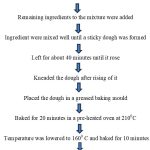 |
Figure 1: Summary for the preparation of bread with composite flour |
After baking, the multigrain bread moulds were taken out of the oven, allowed to cool, and then the cooked bread was removed from the mould, sliced, and properly packaged16. The germinated soybean flour and germinated ragi flour was were mixed in three compositions (Table 2).
Table 2: Different Compositions of the whole wheat flour with Germinated Soybean and germinated ragi flour bread Variation.
| Ingredients | Control bread (A) | Variation-I
(B) |
Variation-II
(C) |
Variation-III
(D) |
| Whole wheat flour (g) | 100% | 80 | 60 | 40 |
| Germinated Soybean flour (g) | – | 10 | 20 | 30 |
| Germinated Ragi flour (g) | – | 10 | 20 | 30 |
| Yeast (g) | 3 | 3 | 3 | 3 |
| Margarine (g) | 5 | 5 | 5 | 5 |
| Vanilla (g) | 1 | 1 | 1 | 1 |
| Salt (g) | 1 | 1 | 1 | 1 |
| Water (ml) | 60 | 60 | 60 | 60 |
| Sugar (g) | 20 | 20 | 20 | 20 |
| Baking powder (g) | 2 | 2 | 2 | 2 |
Phytochemical Screening of germinated and raw flour
For phytochemical analysis 1 g test flour was mixed well with 10 mL of sterile distilled water, mixed well and filtered through four layers of muslin cloth followed by centrifugation at 5000 x g for 15 min. The pellet was discarded and the supernatant was used as flour extract.
Steroids and Phytosterols
Test sample included 0.5 mL of flour extract, to which 2 mL of H2SO4 and 2 mL of acetic anhydride were added. The change of color from violet to blue-green shows the presence of steroids and sterols.17
Terpenoids
0.5mL of the test flour extract was mixed with 2 mL of chloroform in a 5 mL container, and then concentrated H2SO4 was added to produce a separate layer. The formation of a reddish-brown coloring at the interface was indicative of the presence of terpenoid.17
Tannins
0.5 mL of the flour extract was mixed with 20 mL of water in a test tube. The mixture was boiled, filtered and few drops of 0.1% (w/v) ferric chloride were added to observe a brownish-green or blue-black coloring which suggested the presence of gallic tannins by a blue hue, whereas the presence of catecholic tannins was indicated by a green-black color.17,18
Alkaloids
2 mL of flour extract + 1.5 mL of 1% HCl were added into a test tube and heated on a water bath for few minutes. Six drops of Wagner’s reagent were added and the production of an orange precipitate indicated the presence of alkaloids.18
Phenols
A solution containing 1% ferric chloride was mixed with 2 mL of the wheat extract. A blue or green tint in the mixture indicated the presence of phenols.
Reducing sugars
5 mL distilled water was mixed with 2 mL of crude flour extract, and the mixture was filtered. The filtrate was then brought to boil for two minutes while extra Fehling’s solutions A and B (1-2 mL) were added (three to four drops of each). The presence of reducing sugars was tested by the production of an orange-red precipitate.18,19
Flavonoids
5 mL distilled water was combined with 2 mL of crude flour extract to which 0.3 mL of 5% (w/v) sodium nitrite was added, allowed to wait for 5 minutes, and then 0.6 mL of 10% aluminium chloride solution was added, mixed well. The resultant mixture was allowed to react for 6 minutes and then 2mL of 1N sodium hydroxide was added followed by thorough mixing. Water was added to make final volume of 10mL. The absorbance was read at 510 nm against distilled water as blank in a Double beam UV-Spectrophotometer (model 2206) and quercetin standard (R=0.9992) was used as standard.
Physico-chemical analysis of Bread
The techniques suggested by AOAC were used to determine the chemical composition of the bread samples, including their moisture, ash, protein, fat, and crude fiber contents. The water conversion factors were used to compute energy, and the difference method was used to calculate carbohydrates.20
The bread’s properties, including its volume, bread specific volume, and dough expansion, were measured. 9, 21
Sensory Evaluation of Bread
For sensory properties, forty panelists participated in a sensory assessment. Samples of bread produced using different flour mixes were distributed to each panelist. Water was offered for palate cleaning in between sampling. The panelists were requested to rate the sensory attributes of bread in terms of texture, color, taste, flavor, and overall acceptability on a 9-point hedonic scale, which goes from 1 (strongly detest) to 9 (strongly like).
Statistical analysis
Statistical analysis was made using completely randomized design (CRD) for all treatments. Data were subjected to an analysis of variance22 which showed significance at the P<0.05 level, S.E., and C.D. at the 5% level.
Results
Phytochemical screening of whole wheat flour, germinated Soybean and Ragi flour
Phytochemical analysis of raw and germinated soybean and finger millet flours, along with whole wheat flour, is presented in Table 3. Terpenoids, phenols, alkaloids, reducing sugars, and flavonoids were detected in whole wheat flour, but tannins and steroids/phytosterols were absent. Raw finger millet flour showed the presence of terpenoids, tannins, alkaloids, phenols, reducing sugars, and flavonoids, whereas steroids and phytosterols were found only in germinated finger millet and soybean flours. This indicates that germination enhanced the phytochemical profile, particularly by introducing steroids and phytosterols which were not present in the raw forms. Overall, all samples were rich in multiple phytochemicals, though their type and intensity varied depending on the flour and its processing stage.
Table 3: Phytochemical Screening of Whole Wheat Flour, raw and germinated Finger Millet and Soybean flour (each figure is an average of 3 independent observations).
| PHYTO-CHEMICALS | TESTS | Whole Wheat Flour | Raw Finger Millet Flour | Germinated Finger Millet Flour | Raw Soybean Flour | Germinated Soybean Flour |
| Steroids and Phytosterols | Acetic anhydride and H2SO4 | _ | _ | + | _ | + |
| Terpenoids | Chloroform and H2SO4 | + | + | + | + | + |
| Tannins | Ferric Chloride Test | _ | + | + | + | + |
| Alkaloids | Wagner’s Test | + | + | + | + | + |
| Phenols | Ferric Chloride Test | + | + | + | + | + |
| Reducing Sugar | Fehling’s Test | + | + | + | + | + |
| Flavonoids | With Ammonia
Solution |
+ | + | + | + | + |
+ means present; – means absent
Physico-chemical analysis of Multigrain Bread
Table 4 shows the proximate composition of breads prepared using whole wheat flour and varying levels of germinated soybean and ragi flours. Compared to the control bread, the composite flour breads exhibited higher levels of moisture (30.12 to 38.72%), protein (8.84 to 14.92%), fat (3.85 to 5.08%), crude fibre (3.50 to 5.28%) and ash (1.93 to 2.70%). Conversely, carbohydrate content and energy values decreased with increased supplementation, from 51.76% to 33.3% and 294.12 to 245.78 Kcal respectively. The results clearly indicate that incorporation of germinated soybean and ragi improved the nutritional profile of breads, especially in terms of protein and fibre, while slightly reducing carbohydrate density. Such variations highlight the positive effect of composite flour blending on the overall nutrient balance of the product.
Physical characteristics of bread prepared with whole wheat flour, Germinated Soybean and germinated Ragi flour
The physical parameters of breads supplemented with germinated soybean and ragi flours are summarized in Table 4. Bread volume decreased progressively with supplementation, from 290 cm³ (control) to 180 cm³ (30% substitution). Dough expansion also reduced from 450 cm³ to 390 cm³, and specific volume decreased from 0.82 to 0.49 cm³/g. This shows that higher levels of composite flour incorporation adversely affected loaf volume and aeration, leading to denser bread structure. The reduction in specific volume was more pronounced at higher substitution levels, indicating limited gas retention capacity in the dough when compared to control bread.
Table 4: Proximate analysis and physical characteristics of bread prepared with whole wheat flour, germinated soybean and ragi flour bread variations.
| Parameters | Bread samples | |||
| Control Bread | Variation I | Variation II | Variation III | |
| A | B | C | D | |
| Moisture (%) | 30.12 ±0.15 | 33.56 ±0.17 | 36.41 ±0.09 | 38.72 ±0.32 |
| Protein (%) | 8.84 ±0.18 | 10.42 ±0.27 | 13.56 ±0.21 | 14.92 ±0.11 |
| Fat (%) | 3.85 ±0.05 | 4.12 ±0.15 | 4.56 ±0.13 | 5.08 ±0.12 |
| Crude fiber (%) | 3.50 ±0.09 | 4.02 ±0.11 | 4.95 ±0.22 | 5.28 ±0.15 |
| Ash (%) | 1.93 ±0.21 | 2.25 ±0.07 | 2.58 ±0.18 | 2.70 ±0.27 |
| Carbohydrate (%) | 51.76±0.22 | 45.63±0.18 | 37.94±0.15 | 33.3±0.25 |
| energy value (Kcal) | 294.12±0.43 | 271.65±0.25 | 259.38±0.28 | 245.78±0.31 |
| Bread Characteristics | ||||
| Bread volume (cm3) | 290±0.15 | 270±0.25 | 230±0.25 | 180±0.20 |
| Dough expansion (cm3) | 450±0.15 | 425±0.20 | 410±0.15 | 390±0.25 |
| Specific volume (cm3/g) | 0.82±0.08 | 0.73±0.13 | 0.62±0.15 | 0.49±0.10 |
Each value is the means ± standard error of three independent replicates. (A- 100% WF; B – 80%WF+ 10% GSBF + 10% GRF; C– 60%WF + 20% GSBF + 20% GRF; D- 40%WF + 30% GSBF + 30% GRF (WF- wheat flour; GSBF- germinated soybean flour; GRF- germinated ragi flour).
Sensory Characteristics of Bread made from whole wheat flour, germinated soybean flour and germinated ragi flour
Table 5 presents the sensory evaluation of the breads. The control sample received the highest overall acceptability score (7.05), followed by breads with 10% (7.00) and 20% (6.55) substitution of germinated soybean and ragi flours. Bread prepared with 30% substitution scored the lowest (6.25). With higher substitution levels, crust and crumb color values decreased, and flavor and texture scores were also negatively affected compared to control and lower substitution breads. This indicates that while moderate incorporation (10–20%) was fairly acceptable to the panelists, excessive substitution (30%) led to a decline in sensory quality. The reduction in lightness of crumb and slight beany flavor from soybean were the main factors influencing lower scores at higher substitution levels.
Table 5: Sensory characteristics of bread made from whole wheat flour, germinated soybean flour and germinated ragi flour.
| Samples | Crust Color | Crumb Color | Flavor | Taste | Texture | Overall acceptability |
| A (control) | 7.10±0.15 | 7.00±0.27 | 7.6±0.25 | 7.50±0.75 | 6.85±1.00 | 7.05±0.70 |
| B (10% composite) | 6.52±0.29 | 6.36±0.35 | 7.35±0.25 | 7.00±0.60 | 6.5±1.00 | 7.00±0.70 |
| C (20% composite) | 6.25±0.21 | 5.55±0.15 | 7.05±0.50 | 7.00±0.85 | 7.1±0.50 | 6.55±0.50 |
| D (30% composite) | 6.00±0.50 | 5.00±1.00 | 6.5±0.50 | 6.00±0.25 | 6.00±0.50 | 6.25±0.50 |
(Each values is the means ± standard error of three independent replicates. (A– 100% WWF; B – 80%WWF+ 10% GSBF + 10% GRF; C– 60%WWF + 20% GSBF + 20% GRF; D- 40%WWF + 30% GSBF + 30% GRF); WWF- Whole Wheat flour; GSBF- germinated soybean flour; GRF- germinated Ragi flour
Discussion
The phytochemical screening revealed that germination enhanced the presence of bioactive compounds such as phytosterols and steroids in soybean and ragi flours, which were absent in their raw counterparts. These phytochemicals are widely known for their role in managing biological and metabolic activities including antioxidant, antimicrobial, anti-inflammatory, and anti-plasmodial properties with numerous health benefits.23 Steroids are known to disrupt the lipid-bilayer membrane, resulting in the release of liposomes.24 Similarly, saponins derived from biological cells release enzyme proteins, while terpenoids contribute to weakening microorganisms by breaking down their tissues and cell walls, thereby assisting in disease management.25 Previous reports from our laboratories have also described several health benefits of various phytochemicals.26 Yang and Ling27 have highlighted that phytochemicals, though non-nutritive, have significant physiological functions such as antioxidant, anti-inflammatory, anti-aging, antimicrobial, anticancer, lipid profile regulation, cardiovascular protector, neuro-protector, and immunity regulator. The blending of wheat flour with germinated composite flours thus adds substantial nutritional and therapeutic value to bread. In particular, phytosterols found in germinated finger millet and soybean flour are highly beneficial for heart health as they absorb cholesterol in the gut and reduce its levels in the bloodstream.28 In the context of the post-COVID-19 era, where consumer preference for functional, plant-based diets is rising, germinated multigrain breads represent a highly relevant innovation.
The proximate composition of the multigrain breads demonstrated clear nutritional enhancement with the supplementation of germinated soybean and ragi flours. The elevated protein levels are attributed to the protein-rich nature of soybean 33 and germinated ragi7, while the increase in fibre content results from the presence of lignin, cellulose, and hemicelluloses in these flours.10 High dietary fibre is strongly associated with improved digestive health, reduced cholesterol and glucose levels, and enhance gut microbiome diversity, which collectively support overall metabolic health.29 Similar improvements in protein content following soy supplementation have been documented earlier.4 On the other hand, the higher moisture content observed in the composite breads may shorten shelf life due to a higher risk of microbial spoilage.9 Therefore, while nutritional improvement is significant, moderation in substitution levels is important for balancing both product stability and consumer acceptability. A substitution level of 20% appears optimal for industrial application, ensuring extended nutrition without compromising storage quality.
The physical characteristics of the multigrain breads showed a decline in loaf volume, dough expansion, and specific volume with increasing substitution levels. This reduction is largely due to the dilution of gluten content and the interference of additional fibre, which weakens the dough matrix and reduces gas retention during proofing and baking.4, 32, 38 These findings are consistent with earlier reports on soy flour supplementation, where loaf volume and texture were negatively impacted.9, 10 However, at the 20% substitution level, the breads retained acceptable loaf characteristics, striking a balance between nutrition and baking quality. This suggests that moderate incorporation of germinated soybean and ragi flour can enrich breads without causing drastic structural or handling issues.
The sensory evaluation further supported these findings. Although, the control bread (100% wheat flour) scored the highest in overall acceptability, breads with 10% and 20% substitution of germinated soybean and ragi flours showed comparable consumer acceptance. Declines in crust and crumb color with increasing substitution were mainly attributed to the natural darker pigments of ragi and soybean, along with intensified Maillard reactions during baking1. Similarly, flavor and texture were negatively affected at higher substitution levels due to the slight beany flavor of soybean and the denser crumb structure. These trends are in agreement with earlier studies, which also reported reduced sensory quality at higher levels of soy incorporation.41Interestingly, breads with 20% substitution achieved a favorable compromise between nutritional enhancement and consumer acceptability. This aligns with other product development studies, such as those on cookies made with sprouted ragi flour, which also highlighted that partial substitution provided better sensory outcomes.39, 40
Overall, the results confirm that germination significantly improves the phytochemical and nutritional composition of soybean and ragi flours, and their incorporation into bread enhances protein, fibre, and mineral content while reducing carbohydrate and energy values. Despite some reduction in loaf volume and sensory scores at higher levels of substitution, moderate incorporation (around 20%) of germinated flours yields nutritionally superior bread with satisfactory consumer appeal. These findings are in agreement with earlier reports on soy and millet fortification in bakery products.27, 28, 41, 42, 43 reinforcing the potential of germinated multigrain breads as functional foods that meet modern dietary preferences.
Based on nutritional profile, multiple health benefits and biological active molecule of tiny sprouts are commonly known as “superfoods”. Tiny sprouts are rich in antioxidants, minerals, enzymes, improve blood sugar levels, manage anemia and act as anti-nutrients, lower the risk of heart-related diseases and congenital disabilities. In post covid-19 era, sprouts are the choice of vegetarians as these are rich in plant-based proteins, considered as powerhouse of essential nutrients, including fiber, vitamins, and minerals, which makes them an excellent addition to a balanced diet. The use of germinated flours in multigrain bread is suggested as functional food having multiple health benefits like prevention of cancer, muscle growth and repair, aid in digestion, strengthening of immunity, improve heart health, control inflammation, promote healthy and shining skin, help in weight loss and balancing of sugar levels. Soy bean and ragi both have multiple health benefits for all ages of people and can add value to the nutritive quality of the food.
Conclusions
Present study reveals that the phytochemicals with antioxidant qualities are present in germinated finger millet and soybean. The per cent concentration of the phytochemical examined increased noticeably after germination and the composite flour breads made with germinated soybean flour and germinated Ragi flour were more nutritious than whole wheat flour bread, with higher levels of protein, fat, and crude fiber. Wheat flour bread, though, had the highest score for sensory acceptability, but the bread prepared with supplementation of 20% of each of the flours from germinated ragi and soybeans, was comparable in color, texture flavor and taste and its increased nutritional value suggest it as healthy bread. Substitution of 20% of composite germinated ragi and 20% soybean flour is acceptable in terms of sensory properties.
The high fiber, protein and fat content with low carbohydrate, the multigrain breads may be considered as useful healthy food. However, further investigations are suggested with respect to their anti-nutrient content and functional aspects of soybean ragi-enriched breads, as well as strategies for enhancing their organoleptic features and, consequently, their appeal. The sensory acceptance of the soy-enriched bread may be enhanced by educating the public about the nutritional advantages of the germinated soybean-ragi supplemented functional meals. To enhance the composite bread features, it is also necessary to modify the baking methods and components for mixing.
Acknowledgement
The authors would like to thank Pro Vice Chancellor, Professor Jayanand, SIET, Meerut for granting the Ph.D. research work.
Funding Sources
The author(s) received no financial support for the research, authorship, and/or publication of this article.
Conflict of Interest
The authors do not have any conflict of interest.
Data Availability Statement
This statement does not apply to this article.
Ethics Statement
This research did not involve human participants, animal subjects, or any material that requires ethical approval.
Informed Consent Statement
This study did not involve human participants, and therefore, informed consent was not required.
Clinical Trial Registration
This research does not involve any clinical trials.
Permission to reproduce material from other sources
Not Applicable
Author’s Contributions
Vishal Chaudhary: Conducted the experimental work, analyzed data,
Amar Prakash Garg: Conceptualized the paper, finally corrected the paper, supervised the experiments.
Umesh Kumar: Assisted in methodology design and development, preliminary analysis of data.
References
- Adewole SA, Adaramola FB, Adewole OA, Ogu HU. Nutritional and sensory quality attributes of bread produced from wheat-sprouted finger millet flour; 2023; 9(2). https://doi.org/10.57233/ijsgs.v9i2.456.
CrossRef - Chaudhary Vishal, Garg AP and Kumar Umesh. Physical, nutritional, textural and sensory Properties of wheat bread supplemented with soybean: finger millet and flax seeds flour. J. Nutr. Food Safety. 2024 16 (5): 80-92. DOI: 10.9734/EJNFS/2024/v16i51424.
CrossRef - Rawat M, Varshney A, Rai M, Chikara A, Pohty AL, Joshi A, et al. A comprehensive review on nutraceutical potential of underutilized cereals and cereal-based products. Agr. Food Res. 2023; 12, 100619.
CrossRef - Ghosh Jai, Shraddha Bhosale, Shrushti Halundi, Shruti Chougule, Shrutika S Malgave, Suryakant Wadkar et al. Designing and characterization of different multigrain breads prepared from combination of composite flours. Food Toxicol. 2017 1(6):205-215.
- Ministry of Health Food and nutrition guidelines for healthy adults a background paper, Ministry of Health. Adult Nutrition Survey. Wellington, New Zealand 2003.
- Cakmak H, Burak A, Seher K, Duygu K, Sebnem T. Production of crispy bread snacks containing chicken meat and chicken meat powder. Anais da Acad. Brasil de Ciências 88(4): 2387-2399. https://doi.org/10.1590/0001-3765201620150059.
CrossRef - Rosy Bansal, Monika Hans. Quality evaluation of whole wheat bread fortified with germinated ragi flour’, J. Curr. Adv. Res. 2018 7(9):15312-15318. DOI: http://dx.doi.org/10.24327/ijcar.2018. 15318. 2794.
- Anurag, Garg AP. Qualitative Evaluation of Germinated Multi-Millet-Based Functional Snack Product, 2022 34(24): 620–629, ISSN No. – 2320-7035. DOI: 10.9734/IJPSS/2022/v34i242682.
CrossRef - Joel Ndife, Abdulraheem LO, Zakari UM. Evaluation of the nutritional and sensory quality of functional breads produced from whole wheat and soya bean flour blends; J. Food Sci. 2011, 5(8):466 – 472.
- Islam T, Chowdhury A, Islam M, Islam S. Standardization of bread preparation from soy flour. J. Sustain. Crop Prod. 2007 2(6): 15-20.
- El Gharras H. Polyphenols: food sources, properties and applications – a review. J. Food Sci. Technol. 2009, 44: 2512-2518. DOI:10.1111/j.1365-2621.2009.02077.x.
CrossRef - Sharma Shikha, Garg, Amar P. Evaluation of physical, chemical and sensory properties of multigrain cookies prepared using wheat, oats and barley flours. J. Plant Soil Sci., 2022. 34(24): 908-921, 2022; Article no.IJPSS.95742 ISSN: 2320-703.
CrossRef
- Sharma Shikha, Anurag, Garg AP. Effect of germination on the physicochemical and antinutritional properties of finger millet (Eleusinecoracana), pearl millet (Pennisetum glaucum), and sorghum (Sorghum bicolor). Pharma Innovation. 2023, 12(3): 4763-4772.
- Victoria A, Jideani, Felix CO. Optimization of wheat-sprouted soybean flour bread using response surface methodology; J. Biotechnol. 2009, 8 (22):6364-6373 DOI:10.5897/AJB09.707.
CrossRef - AACC Approved Methods of the American Association of Cereal Chemists, 2000, 10th Ed. AACC, St. Paul, MN, USA.
- Mounika D, Sireesha G. Development of Multi Millet Bread with Pearl Millet and Sorghum Millet; Wesleyan J. Re.s, 2021. 14(80).
- Sivaraj R, Balakrishnan A, Thenmozhi M, Sivaraj VR. Preliminary phytochemical analysis of Aegel marmelos, Ruta graveolens, Opuntia dellini, Euphorbia royleana and Euphorbia antiquorum. J. Pharma Sci. Res. 2011. 2 (1): 146-150. http://dx.doi.org/10.13040/IJPSR.0975-8232.2(1).132-36.
CrossRef - Oluwapelumi E. Adurosakina, Emeka J Iweala, Johnpaul O Otikec, Emmanuel Dike Dikec, Miracle E Uchec, Julie I Owanta d, et al. Ethnomedicinal uses, phytochemistry, pharmacological activities and toxicological effects of Mimosa pudica– A review, Res. Mod. Chin. Med. 2023, 7:100241. https://doi.org/10.1016/j.prmcm.2023.100241.
CrossRef - Venkatesan D, Karrunakarn CM, Kumah SK, Palani SPT. Identification of phytochemical constituents of Aegle marmelos responsible for antimicrobial activity against selected pathogenic organisms. Ethnobot. Leaflets. 2009. 13: 1362- 72.
- AOAC Official Methods of analysis. 15th ed. Association of Official Analytical Chemists. 1990 Washington, DC.
- Jacobs BM. The Chemical Analysis of Foods and Food Products. 1999. 3rd ed. CBS Publishers and Distributors. New Delhi, India.
- Panse GV, Sukhatme PV. Statistical Method for Agricultural Workers. 1985. ICAR, New Delhi.
- Zongo E, Busuioc A, Meda RN-T, Botezatu AV, Mihaila MD, Mocanu A-M et al. Exploration of the antioxidant and anti-inflammatory potential of Cassia sieberiana DC and Piliostigma thonningii (Schumach.) Milne-Redh, traditionally used in the treatment of Hepatitis in the Hauts-Bassins region of Burkina Faso. 2023, 16, 133. https://doi.org/10.3390/ph16010133.
CrossRef - Crowley J, Withana M, Deplazes E. The interaction of steroids with phospholipid bilayers and membranes. Rev. 2021, 14(1), 163-179. DOI: 10.1007/s12551-021-00918-2.
CrossRef - Kholif AE. A Review of Effect of Saponins on ruminal fermentation, health, and performance of ruminants. Sci. 2023 10, 450. https://doi.org/10.3390/vetsci10070450.
CrossRef - Chaudhary Vishal, Grag Amar P, Kumar Umesh. Health management using millets, Clin. Exp. Pathol. 2025. 4(1), Doi:10.31579/2834-8508/043.
CrossRef - Yang, Yan, Wenhua Ling Health benefits and future research of phytochemicals: A literature Review. J Nutr 2025 87-101 https://doi.org/10.1016/j.tjnut.2024.11.007.
CrossRef - Zio Souleymane, Bakary Tarnagda, Frrancois Tapsoba, Cheikna Zongo, Aly Savadogo. Health interest of cholesterol and phytosterols and their contribution to one health approach: Heliyon 2024 10:e40132. https;//doi.org/10.1016/j.heliyon.2024.e40132.
CrossRef - Bamal Anchal, Garg Amar. Lactic acid bacteria isolated from human feces of vegetarian and non-vegetarians. Biotechnol. Res. Asia 2025 22(2), DOI : http://dx.doi.org/10.13005/bbra/3402.
CrossRef - Garg AP, Goley R, Bamal A. Management of obesity related diseases through the gut microbiome. Microbes & Imm. 2025 doi: 10.36922/MI025160036.
CrossRef - Gurkirat Kaur, Navjot Kaur Development and Nutritional Evaluation of Multigrain Bread Supplemented with Sunflower Seed (Helianthus annuus) Flour; Chem Sci Rev Lett 2020, 9 (34), 298-305 DOI:10.37273/chesci.CS20510125.
- Elleuch M, Bedigian D, Roiseux O, Besbes S, Blecker C, Attia H. Dietary fibre and fibre-rich by-products of food processing: Characterization, technological functionality and commercial applications: Food Chem. 2011, 124: 411-421. https://doi.org/10.1016/j.foodchem.2010.06.077.
CrossRef - Lakshmi Menon, Swarnali Dutta Majumdar,Usha Ravi. Development and analysis of composite flour bread, Food Sci. Technol., 2015, 52(7): 4156–4165 doi: 10.1007/s13197-014-1466-8.
CrossRef - Dhanimsetti S, Kothakota A, Ranasalva N, Bodhankar HB, Chavan PD. Development of Composite Flour Bread and its Effect on Physical, Sensory and Nutritional Characteristics. Intl. J. Agric. Sci., 2016, ISSN: 0975-3710 & E-ISSN: 0975-9107, 8 (57): 3110-3114.
- FAO / WHO / UNU Report of a Joint Expert Consultation. Energy and Protein Requirements, World Health Organization Technical Report Series Geneva: WHO. 1985 ISSN 0512-3054.
- Serrem C, Kock H, Taylor J. Nutritional quality, sensory quality and consumer acceptability of sorghum and bread wheat biscuits fortified with defatted soy flour. J. Food Sci. Technol. 2011, 46: 74-83. doi:10.1111/j.1365-2621.2010.02451.x.
CrossRef - Gomez M, Ronda F, Blanco, Caballero P, Apesteguía A. Effect of dietary fibre on dough rheology and bread quality. Food Res. Technol. 2003 216: 51-56.
CrossRef - Eimam H, Amir M, Mustafa A. Effect of Fermentation and particle size of wheat bran on the antinutritional factors and bread quality. Pak J. Nutr. 2008 7(4): 521-526. DOI: 3923/pjn.2008.521.526.
CrossRef - Goswami Priyanka, Mayank Mehra, Parihar , Pratibha. Studies on proximate composition of ragi based developed instant mixes. J. Curr. Microbiol. Appl. Sci. 2017 6(8):3401-3405. DOI: https://doi.org/10.20546/ijcmas.2017.608.407.
CrossRef - Rana G K, Mishra SP, Duggal A, Shuhla SS, Singh NK, Rahangdale HK. Proximate and sensoric attributes of sprouted ragi flour (SRF) supplemented cookies. The Pharma Innov. J . 2021, 10(10):2432-2435.
- Aanchal Bansal U, Bansal V, Sobti A K, Pradhan R. Study on the effect of germination on the nutritive value of finger millet-cum-wheat for developing bread. R&D of Functl. Food Prod. 2024, 1(5): 15-32. DOI: https://doi.org/10.31989/RDFFP.v1i5.1343.
- Pokharel Anusha, Anish Dangal, Sunita Karki, Sujata Lamichhane, Prekshya Timsina, Anamika Bohara. Study on the effect of different treatments on soy flour, and quality and sensory evaluation of prepared biscuits incorporated with oats and soy flour. Legume Sci. 2023 5:e181 DOI: 10.1002/leg3.181.
CrossRef - Tatala SG, Ndossi DA, Mamiro P. Effect of germination of finger millet on nutritional value of foods and effect of food supplement on nutrition and anaemia in Tanzanian children. Health Res. Bull. 2007, 9(2):77- DOI: 10.4314/thrb.v9i2.14308.
CrossRef

This work is licensed under a Creative Commons Attribution 4.0 International License.